

Screens for Iron Ore Processing
- Jul 30, 2024
- 3 min read
Updated: Jul 31, 2024
Screening
Industrial screening is a widely used process for separating materials by size, ranging from 300 mm down to around 40 μm. However, the efficiency decreases as the particle size gets finer. Dry screening is generally limited to materials above 5 mm, while wet screening is commonly used for sizes down to 250 μm and can go as low as 40 μm.
Call 824093968 to get a quote for Screens
How Screening Works
At its core, screening involves a surface with many uniform apertures or holes. Particles are presented to this surface, and those smaller than the apertures will pass through, while larger particles will be retained.
Types of Industrial Screens
There are several types of industrial screens, including:
Static screens (grizzlies)
Trommels
Flip-flow screens
Circular screens
Linear screens
Call 824093968 to get a quote for screens
Vibrating Screens
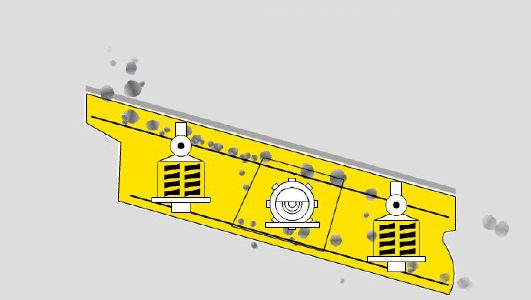
Vibrating screens are the most commonly used type in industrial applications. They have a rectangular screening surface with feed and oversize discharge at opposite ends. Vibrating screens are used for sizing, grading, scalping, dewatering, wet screening, and washing.
The vibrating motion is produced by mechanisms based on eccentric rotating masses, with an amplitude of 1.5–5 mm and operating at 700–1000 rpm. This vibration induces stratification of the feed material, allowing finer particles to work through the layer to the screen surface while larger particles rise to the top.
Multiple-deck vibrating screens can produce a range of sized fractions from a single screen, with the feed introduced to the top coarse screen and the undersize falling through to the lower screen decks.
Inclined and Circular Motion Screens
Inclined or circular motion screens are a type of vibrating screen widely used for sizing applications. A vertical circular or elliptical vibration is induced mechanically by the rotation of unbalanced weights or flywheels attached to a single drive shaft. The amplitude of throw can be adjusted by adding or removing weight elements.
Single-shaft screens must be installed on a slope, usually between 15° and 28°, to permit the flow of material along the screen.

Grizzly Screens
Very coarse material is usually screened on an inclined screen called a grizzly screen. Grizzlies are characterized by parallel steel bars or rails set at a fixed distance apart, with gaps usually greater than 50 mm and up to 300 mm. The most common use of grizzlies in mineral processing is for sizing the feed to primary and secondary crushers.
Horizontal and Banana Screens
Horizontal low-head or linear vibrating screens have a horizontal or near-horizontal screening surface, requiring less headroom than inclined screens. While they have superior accuracy in particle sizing compared to inclined screens, they have lower capacity due to the lack of gravity assistance in transporting material along the screen.
Banana or Multislope screens have become widely used in high-tonnage sizing applications where both efficiency and capacity are important. These screens have a variable slope, typically around 40–30° at the feed end, reducing to 0–15° at the discharge end. The steep sections cause the feed material to flow rapidly at the feed end, enabling faster screening of fine material, while the decreasing slope toward the discharge end slows down the remaining material for more efficient screening of near-size particles.
Rotary Scrubbers
Rotary Scrubbers are cylindrical drums with internal lifters, typically supported by trunnion rollers at either end. These high-capacity, high-retention time machines are primarily used to remove water-soluble clays, deleterious materials, and coatings from a wide variety of hard rock and ore.
Call 824093968 to get a quote for Screens


Comments